Showing posts with label Terry Phebey. Show all posts

Monday, September 29, 2014

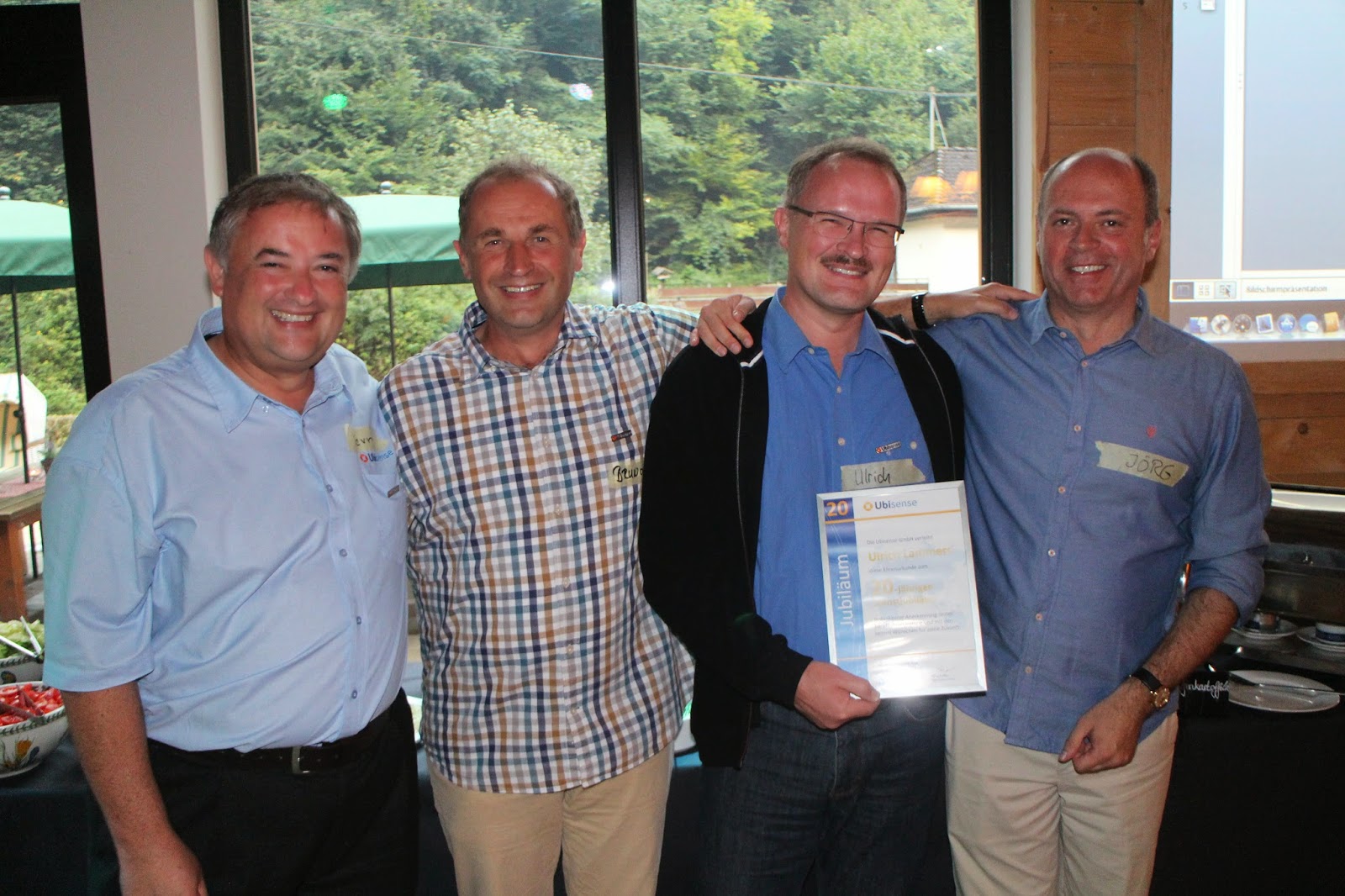
Ubisense Germany Celebrates 10th Anniversary

To celebrate the 10th anniversary of Ubisense Germany, the Ubisense team met in Bendorf to partake in some team-building activities (geocaching) and to enjoy a celebratory barbecue. 


Tuesday, February 25, 2014

"Big Challenges Off the Road" by Automotive Manufacturing Solutions

The volumes may be lower and the unit size larger, but the logistical and manpower issues involved in off-highway manufacturing are similar to the automotive industry
CaterpillarThe manufacture of huge off-road vehicles follows many of the same processes found in automotive production. Most of these models are made using flow line processes with line-side kitting and sequenced logistics; the main difference comes in the sheer size and weight of the components and subassemblies.

The Caterpillar Peterlee facility in Durham, UK, is the worldwide manufacturing location for Caterpillar Articulated Trucks and currently produces a six-model range, four with different engine variants that tip the load and two which eject it. Phil Handley, facilities managing director, explains: “We make vehicles with a capacity starting at 25 tonnes right through to a 43-tonne machine. We have machines that we sell into regulated countries from an emissions perspective – tier 4 compliant machines – and we have machines that we can sell to the rest of the world where the emissions regulations are not quite as tight.”

Product variation is quite limited. Unlike their automotive counterparts, off-road vehicle manufacturers generally do not face the constant churn of new models on an annual basis which necessitates re-tooling and significant line changes. “Our cycles are very different from automotive models and lately they tend to be emissions driven,” states Handley. “We are just going through the launch of the tier 4 compliant product along with most of our competitors,” he says, adding that elements of a base model tend to be updated before a new generation is launched.

In addition to the narrower model range, paintshop is less taxing; the majority of construction equipment is yellow, although specific colour schemes for off-highway vehicles such as military camouflage are sometimes requested.
 

Scope as well as scale
Handley refers to the manufacturing philosophy at Peterlee as “flat plate to gate”, with only the drivetrain not manufactured on site. All the drivetrains feature Caterpillar components (gearboxes, axles and engines) that are brought into the plant in sequenced line-side deliveries.

“We receive flat sheet steel and then go through the standard processes where we cut, bend, weld, paint,” he explains. “We then have a single piece flow line where we assemble various models. It is not actually a physically moving line such as you would find in an automotive assembly plant, but we use product movers to index move the machine along the line as it grows.”
 

There is only a small amount of automation. “We use laser cutting technology and we use robots for welding,” says Handley. “We have an automotive paint plant, but that is not automated. There is more automation in the fabrication process as there are more repeatable processes that we can modular-build.”

When it comes to capacity, line speed and throughput, Handley is somewhat cagey. “We have got capacity in place that meets industry demand and we are continually investing in that capacity,” he states. “We are flexible with our working patterns; we can move people in and out of the process to match the seasonality or cyclical demand, so we can manage peaks and troughs with our process.”

Tackling the size issue

From an automotive perspective, the major difficulty with off-highway vehicles is their sheer size. “The scalability is certainly a challenge,” Handley says. “But you have to bear in mind that, compared to some of the large mining trucks that are manufactured elsewhere within the group, our product is not particularly large; you would fit our completed truck inside the body of one of those [trucks].”

Nonetheless, Handley admits that the scale of moving the parts is certainly a challenge. “But we make our own trolleys and stillages and we have huge cranes to move the components around,” he states. “The actual dump body sits on a special stand that can be raised by a fork-lift and moved to a required position.”

Along with the size and scale of the components, there are ergonomic issues to be addressed. “You need the people who are involved in the manufacturing process to be safe and to be able to move and manipulate heavy components,” explains Handley. “So that can become a challenge and we have had to develop some bespoke equipment that we use to fit various components to the machine.”

A further complication caused by the size of the vehicles, components and assemblies is the space needed for line-side logistics. When working on a flow line, modules need to be available at the right point and at the right time. According to Handley, some of the order-specific, sequencing activities where various options are matched with the product as it moves along the line mean that a large area is required. “We don’t have a lot of opportunity for things to go wrong as we are moving through the manufacturing process, as realigning products is difficult.”


The active tags used in Ubisense’s Smart Factory System transmit data several times per second
Manpower and ongoing needs
Another key challenge faced by Caterpillar and other heavy vehicle manufacturers is staffing. “Along with the process, it is the skills that are our biggest problem,” confirms Handley. This means attracting, developing and retaining the skills that are needed across the full range of positions: welders, fabricators, painters, electricians, manufacturing engineers and design engineers.

“It is quite a challenge attracting young, talented people into the industry,” states Handley. He believes the problem is particularly acute in the off-highway sector: “Maybe automotive companies don’t find it so difficult, but at this end of the market we do." He explains that heavy manufacturing is "not always viewed as an attractive career” because it is seen as a “dirty, dark and dank type environment” – but that this is far from the truth. Peterlee, for one, is a high-tech facility with a clean environment despite the heavy fabrication.
Placing progress in real time
At the AGCO factory at Marktoberdorf in Germany, a recent installation of a Manufacturing Execution System (MES) was being hampered by incorrect data entry during the assembly process. The company opted to automate this activity using the Ubisense Smart Factory System. Over the 4,000m2 area, AGCO fitted 76 sensors and 200 real-time location system (RTLS) tags. By precisely tracking the tags on each gear assembly as well as on each subassembly, the company achieved real-time progress monitoring.

“Typically, manufacturers are relying on an operator manually typing in information on a workstation about the job in process,” says Terry Phebey, Ubisense vice-president of marketing. For instance, a gearbox assembly would come into the bay and at a quality control point a worker would have to type information into a terminal or scan a barcode. By instrumenting the area, AGCO was able to eliminate the human data input. The entry of the assembly into the space automatically sends intelligent data to the MES, entirely machine-to-machine.


“All that is required is that at the start of the process the tag is fitted to the part or assembly and an association is made between that part and the serial or bin number,” explains Phebey. “The Smart Factory System uses high-precision UWB real-time location technology combined with GPS for outdoor applications,” he adds. “Users only need three components: active (battery-powered) transponders or tags, designed for different applications; sensors; and software.”


The tags have a unique ID and can, for example, be associated with production data and transmit location radio signals to sensors, which detect the signals and calculate the positions of the tags several times per second. The Ubisense software stores, processes and displays the location data in real time for the user as well as generating events for IT or shop-floor systems.
Customers usually start with a small zone and just a few sensors as proof of concept, then, when they are happy with the ROI and quality metrics, the system is rolled out across the entire assembly process.

Tuesday, December 29, 2009

Ubisense and Atlas Copco Industrial Technique enter development partnership.

Ubisense, the world Leader in precise Real-time Location Systems, and Atlas Copco Industrial Technique, the world-leading provider of industrial productivity solutions, are collaborating in the research and development of real-time locations systems for industrial tooling.

“Collaborating with the world’s leading precise real-time location system provider will allow us to continue to develop innovative solutions for our customers who wish to significantly increase their productivity and quality in these tough economic times,” explains Anders Lindquist, President MVI Division at Atlas Copco Industrial Technique. “We became aware of the potential of the Ubisense approach to real-time location at our mutual customer, BMW in Regensburg, Germany. Subsequent discussions with potential customers for this type of technology not only in the Motor Vehicles market but also in aerospace, mining and construction equipment as well as discrete manufacturing led us to the idea of pooling our knowledge and resources to create a new family of solutions for our customers.”

The Ubisense system is installed in the production facilities of companies such as BMW, Aston Martin, Caterpillar and Honda. The application at BMW called LIS/TAS involves tracking the industrial tools used on the final assembly line and loading the correct program into the tool automatically based on the specific vehicle being worked upon.

“The introduction of LIS/TAS has resulted in the elimination of the need to scan vehicles in order to identify them”, comments Andreas Lehner, project manager at BMW in Regensburg. “All the project objectives have been met on time and within the planned budget. From the standpoint of value creation, the project is a complete success”.

“This unique relationship allows Atlas Copco Industrial Technique and Ubisense to investigate the key innovations that will drive the next set of standards for use in manufacturing production and enable significant process improvements”, comments Terry Phebey, VP Sales Ubisense.

About Atlas Copco Industrial Technique

Atlas Copco’s Industrial Technique business area develops, manufactures and markets industrial power tools, assembly systems, software and service. It innovates for superior productivity for applications in the automotive and aerospace industry, general industrial manufacturing and maintenance, and vehicle service worldwide. Principal product development and main manufacturing units are in Sweden and France.
More information on the company is available at www.atlascopco.com.
Monday, June 04, 2007

Auto ID award win press release

Ubisense receives European Auto ID Award 2007
Release date: 24 May 2007

Ubisense has won the European Auto ID Award 2007 in the category "Innovative Company".

Dortmund, 24th May 2007 - Ubisense has won the European Auto ID Award 2007 in the category "Innovative Company". The award was granted by AIM, the global organisation for the promotion of Auto ID, and IBC EUROFORUM during the Euro ID 2007 trade exhibition which took place for the third time from 8th to 10th May in Cologne, Germany. More than 100 exhibitors presented their RFID solutions at the show to over 3,000 visitors, an increase of 25% over the previous year, demonstrating the fast growing nature of this industry.

The award was received by Terry Phebey, VP Sales and Marketing, Europe for Ubisense who commented: “As a relative newcomer to the industry, we are particularly proud to receive this award for innovation, reflecting the outstanding results achieved by our development team in Cambridge.“ Ubisense attended the exhibition for the first time this year and presented solutions from customer projects in the areas of logistics and manufacturing using the company's real-time location system which is able to track assets and people to an accuracy of 15cm in 3D.

Thorsten Aha, managing editor of Ident magazine, who presented the award to Ubisense on behalf of AIM and EUROFORUM, praised the company for its two-fold innovation: solving the difficult problem of indoor GPS using ultra-wideband and unique sensor technology as well as achieving a global customer presence with over 160 customers in such a short period of time.

Ubisense was not the only company to be granted an award at the exhibition which was opened by representatives from the EU parliament, the German Ministry of Industry and Technology and the mayor of Cologne. DaimlerChrysler AG received the award in the category “RFID“ for its successfully implemented fully card-based Kanban material supply process integrated with SAP at its facility in Untertuerkheim.

Tuesday, May 08, 2007

Ubisense wins European Auto ID Award - "Innovative Company"


Terry Phebey Ubisense VP Sales Europe and Asia receives the award